
About Polarization Beamsplitter Cubes
As laser technology continues to advance towards higher power and precision, the precise polarization of the beam is often a crucial detail determining the success or failure of a system. Polarization beamsplitter cubes (PBS), as a core component in this field, play a role far beyond simple beam splitting; they are vital for energy management, signal-to-noise ratio, and overall stability of laser systems.
When PBS is mentioned, two core actions immediately come to mind: s-off and p-through—the s-component of the incident light is reflected off the inclined plane and emitted at a 90-degree angle, while the p-component is directly transmitted. This seemingly simple physical behavior involves a complex interplay of thin film engineering, bonding processes, and stress control.
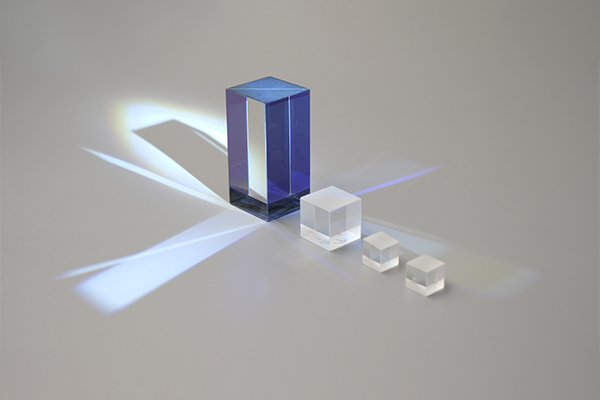
I. More Than Just Bonding: The Energy Watershed from “With Bonding” to “Without Bonding”
Many people’s first impression of a PBS cube is that it is simply a precise glass block. In reality, its core lies in the dielectric coating on the hypotenuse of the two right-angled prisms. The presence of this coating determines the fate of the beam: it is “invisible” to the p-component (high transmission), but “unyielding” to the s-component (high reflectivity).
However, what truly determines whether this cube can be used in a high-energy laser system, besides the coating, is the bonding method between the two prisms.
In conventional industrial applications, MOK Optics offers epoxy-bonded cubes. This process is mature, cost-effective, and extremely convenient for optical path alignment—the most practical solution for laboratory teaching, biomedical imaging, or low-to-medium power OEM equipment. Its advantage lies in the adhesive filling the tiny gaps between the prisms, ensuring minimal transmission wavefront distortion.
But when the scenario shifts to High-Energy Laser Systems, things become more nuanced. Traditional adhesives often become a bottleneck in the system when encountering pulse energies of hundreds of millijoules or even joules. This is not merely a matter of thermal lensing; it’s also a problem of photochemical degradation caused by long-term exposure of the adhesive layer to high peak power.
Simply put, it involves directly bonding two ultra-smooth surfaces through intermolecular forces, without any adhesive layer in between. The benefits of this adhesive-free interface are direct: the laser-induced damage threshold (LIDT) increases exponentially, thermal stability is better, and interference from adhesive layer fluorescence in the ultraviolet band is avoided. It can be said that the shift from “gluing” to “photoadhesive” represents a watershed moment in the transition from low-end to mid-range applications to scientific research and military applications.
II. Narrowband vs. Broadband
In discussions with many system engineers, the most common dilemma is: should they choose a single-wavelength (Laser Line) PBS or a Broadband PBS?
From MOK Optics’ manufacturing experience, this issue is essentially a trade-off between “purity” and “width.”
If your system uses a 1064nm Nd:YAG laser or a 532nm green laser, then the Narrow Band Polarization Beamsplitter Cube is the optimal performance solution. By optimizing the number of layers and materials of the film system for specific wavelengths, MOK Optics can achieve Rs>99.8% and Tp>97%, while achieving an extinction ratio of 1000:1 or even higher. The extinction ratio, simply put, is the purity of transmitted light—it determines how much weak s component is mixed into your p-channel, which directly determines the system’s noise floor for quantum communication or precision measurement.
III. The Physical Intuition Behind the Parameters: When Surface Quality and Materials Become Bottlenecks
For general applications in the visible and near-infrared bands, N-BK7 is the king of cost-effectiveness, with good uniformity and mature processing technology. However, once entering the high-power field or the ultraviolet band, the tiny impurities and metal ions inside BK7 become absorption centers, leading to thermal explosion. At this point, the low coefficient of thermal expansion and extremely low nonlinear absorption of UVFS (ultraviolet fused silica) become essential. Especially in femtosecond laser systems, UVFS materials, combined with specially designed film systems, can effectively control group delay dispersion (GDD) and prevent pulse broadening.
Another often overlooked parameter is Clear Aperture. MOK Optics typically maintains a Clear Aperture of >90% in its designs. This means that in practical use, even if your beam spot is slightly off-center, you don’t need to worry about the beam being edge-triggered or producing stray light. However, a small tip for assembly is worth sharing: the beveled surface coated with the polarizing film usually corresponds to a small mark on the cube. During installation, ensure that the incident light is perpendicular to the input surface and the polarization direction is aligned with the reference surface. This will minimize beam deviation and keep it within the rated 3 arcminutes.
IV. Positioning in Comparison: The Niche of PBS vs. TFP
Although PBS cubes and TFP (Thin Film Polarizer) flat panels often appear in the same booth at various optics exhibitions, their application niches are actually quite distinct.
TFP panels, especially Brewster angle types, possess extremely high damage thresholds due to their air-film interface, making them a common choice for petawatt-level laser systems and ultrafast amplification systems. However, their drawbacks are also obvious: the beam undergoes spatial displacement after passing through the TFP (unless used in pairs), and it is extremely sensitive to the incident angle, often requiring significant time for pitch and yaw adjustments during assembly.
In contrast, the robustness of the PBS cube becomes apparent. It is a “foolproof” precision component—as long as the light enters perpendicularly, the two beams naturally output at a perfect 90-degree angle, with no spatial displacement of the transmitted light. For industrial-grade fiber laser isolators, beam splitters/combiners in fiber optic communications, or precision interferometry systems, this stability and ease of use are irreplaceable.
Conclusion
In summary, the Polarization Beamsplitter Cube is no longer a simple beam splitter in today’s optical world; rather, it’s an epitome of the entire system engineering of polarization management. Whether it’s MOK Optics’ trade-offs in materials and processes, or the engineers’ choices between narrowband and broadband, and between adhesive bonding and photoresist bonding, the ultimate goal is the same: to achieve the most efficient polarization separation without compromising the inherent properties of the laser. Next time you’re setting up your optical path and tightening that small cube frame, perhaps pay closer attention to that invisible thin film—it’s the true protagonist of this polarization magic.